What Are the Top 10 Types of Pushbutton Switches in China?
China’s pushbutton market is broad, practical, and surprisingly easy to misunderstand. Pushbutton Switches may look similar, yet their internal mechanisms, contact ratings, sealing levels, and operating lives can differ sharply. A metal momentary switch on a control panel serves a different purpose from a plastic illuminated switch on factory equipment.
Donald Norman, a leading human-centered design authority, wrote, “Design is really an act of communication.” That principle matters here. A switch communicates action through pressure, travel, color, sound, and resistance. If those signals feel unclear, even a technically reliable product may frustrate operators. Small details matter.
This overview examines ten common types of Pushbutton Switches manufactured or widely supplied in China. It considers momentary, latching, illuminated, emergency-stop, selector, waterproof, anti-vandal, capacitive, piezo, and membrane designs. Each type will be compared through application, construction, electrical performance, durability, and purchasing value. Relevant specifications may include IP protection, panel cutout size, voltage, current, terminal style, and mechanical life.
Numbers need careful checking. A claimed one-million-cycle life may reflect laboratory conditions, not a dusty workshop. That is an important weakness in many product comparisons. Buyers should read datasheets, request samples, and confirm testing evidence before placing volume orders. Certification marks also require verification.
The ranking is therefore practical, not absolute. A low-cost switch may be ideal for a simple machine, while a sealed metal design suits outdoor controls. The best choice depends on the operator, environment, load, and failure risk. There is no universal winner.
Pushbutton Switch Basics and Classification Criteria in China
What Are the Top 10 Types of Pushbutton Switches in China?
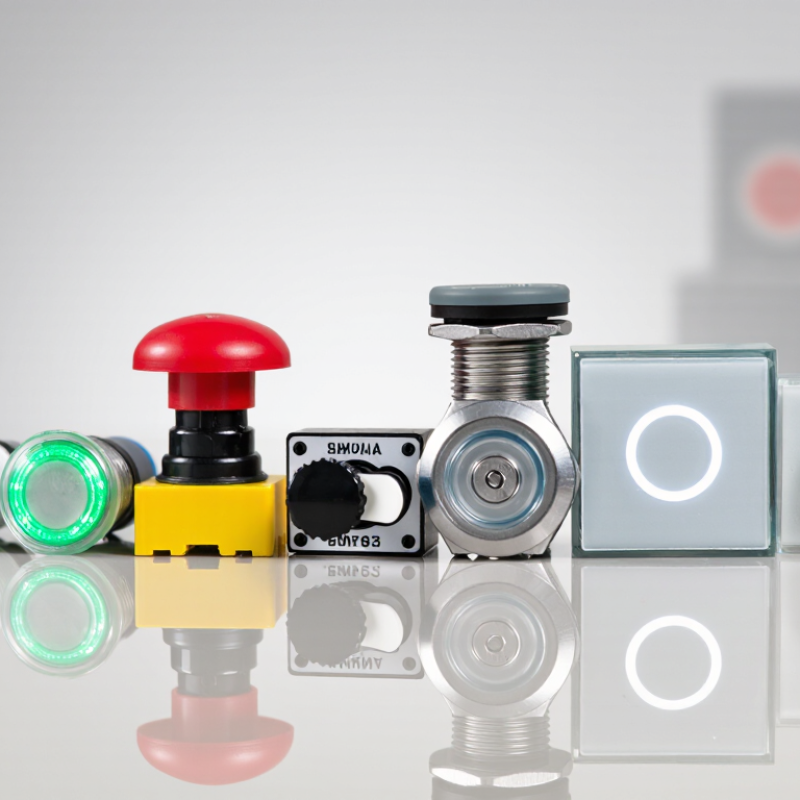
Pushbutton switch selection in China starts with classification, not appearance. The ten common types include momentary, maintained, illuminated, non-illuminated, emergency-stop, selector-push, tactile, waterproof, vandal-resistant, and piezoelectric switches. Each type serves a different control purpose.
A momentary switch returns when released.
A maintained switch stays in its selected state.
That small difference can change machine behavior.
Engineers usually classify these switches by contact action, circuit arrangement, mounting size, electrical rating, and protection level. Normally open and normally closed contacts are common criteria.
IP protection matters in dusty workshops or washdown areas. Panel thickness, terminal style, operating force, and button travel also affect installation.
In China, buyers often compare GB/T requirements with applicable IEC-based specifications. The latest edition should be checked.
Real panel inspections reveal a frequent mistake: selecting a switch by current rating alone.
Heat, vibration, moisture, and repeated pressing can shorten service life.
Illuminated buttons need attention to voltage, light color, and visibility angle.
Emergency-stop designs require clear identification and dependable reset behavior.
A “waterproof” label is not enough. The tested IP level and test conditions should be verified. Product descriptions can be unclear. That deserves careful review.
Cost is another imperfect guide. A cheaper switch may require more frequent replacement, while an oversized model may waste panel space. Reliable classification connects the switch’s function, environment, and compliance evidence.
Top 10 Pushbutton Switch Types Used in Chinese Applications
Chinese applications use pushbutton switches across factory lines, transport equipment, control cabinets, and public facilities. The ten most common types are momentary, maintained, illuminated, mushroom-head, emergency-stop, selector pushbutton, key-operated, waterproof, metal anti-vandal, and piezoelectric switches. Each solves a different control problem.
The International Federation of Robotics reported 276,288 industrial robot installations in China during 2023, representing 51% of global installations. This large automation base supports strong demand for momentary and illuminated buttons on robot cells, conveyors, and inspection panels. Maintained buttons suit simple machine states. Selector pushbuttons help operators choose manual or automatic operation. Emergency-stop and mushroom-head designs provide fast access during abnormal conditions. Key-operated versions restrict casual changes.
Waterproof types are common near food-processing, packaging, and outdoor equipment. Their protection level should be checked against IEC 60529, not assumed from appearance. Metal anti-vandal buttons fit elevators, charging cabinets, and exposed kiosks. Piezoelectric buttons serve clean or high-use panels because they have limited mechanical movement. GB/T 14048.5 and IEC 60947-5-1 provide useful selection references for low-voltage control devices. Still, classification is not absolute. A waterproof button may fail because of cable entry design. An illuminated switch may be difficult to read under factory glare. Field testing remains necessary. Small details matter.
Top 10 Pushbutton Switch Types Used in Chinese Applications
The chart compares common pushbutton switch constructions used in Chinese industrial control panels, machinery, automation equipment, transportation systems, and public facilities. The prevalence index is a comparative industry-use scale, where 100 represents the most frequently encountered type; it is not company or brand market-share data.
Momentary and illuminated momentary switches are widely used for machine commands, while emergency-stop, selector, key-operated, and waterproof types are selected according to safety, access-control, environmental, and operating requirements.
Structural Features and Operating Principles of Each Switch Type
What Are the Top 10 Types of Pushbutton Switches in China?
Chinese control panels commonly use ten pushbutton switch types: momentary, maintained, illuminated, emergency-stop, mushroom, selector, key-operated, waterproof, piezoelectric, and capacitive models. Their structures differ, even when their front panels look similar.
A momentary switch uses a spring-loaded actuator that returns after release. A maintained switch keeps its contact position until pressed again. Illuminated switches add an LED, resistor, and translucent cap for status indication. Emergency-stop and mushroom switches use a large actuator for rapid access, usually with a twist-release mechanism. Selector switches rotate between fixed contact positions. Key-operated switches add a lock cylinder, reducing accidental operation.
Waterproof switches rely on sealing rings, threaded bushings, and protective caps. Piezoelectric switches sense pressure through a ceramic element, with no traditional moving contacts. Capacitive switches detect changes in an electric field behind a smooth panel. These designs improve cleaning and reduce mechanical wear. However, they may require more careful circuit design.
In field inspections, contact bounce, loose terminals, and damaged seals appear often. A switch can look robust but fail under vibration. Rated current, panel thickness, ingress protection, and actuator travel should be checked together. I would not select by appearance alone. Small wiring errors still cause unreliable signals. Testing under heat, dust, and repeated operation gives more trustworthy results.
Key Performance Differences, Standards, and Selection Factors
China’s pushbutton market covers ten practical types: momentary, maintained, illuminated, mushroom, emergency-stop, selector, key-operated, anti-vandal, piezo, and capacitive switches. Each design changes the operator’s feedback and the machine’s response. Momentary buttons return after release, while maintained buttons hold their position. Illuminated versions improve visibility inside control cabinets. Mushroom and emergency-stop models need fast access and clear reset action. Selector and key-operated types restrict accidental changes. Anti-vandal units suit public panels. Piezo and capacitive switches have no moving contacts, which can improve cleaning and service life.
Performance depends on more than appearance. Engineers should compare contact configuration, rated voltage, current, electrical life, mechanical life, and actuation force. Sealed models need a suitable IP rating, especially near coolant, dust, or washdown areas. IK ratings matter where the panel may receive impact. For industrial equipment, review IEC 60947-5-1 and IEC 60204-1, plus applicable Chinese GB standards. Certification requirements can vary by application. Do not assume one certificate covers every installation.
Tips: Define the load before choosing the button. A tiny signal contact cannot replace a power-rated device. Check NO and NC behavior during failure testing. Measure the panel cutout carefully; a few millimeters can stop installation. My field experience suggests that illuminated buttons are often selected for style, not visibility. That choice deserves another review. Also test gloves, oil residue, and repeated operation before final approval. Reliability is proven at the panel, not only in a catalog.
 008613968780263

 CONTACT NUMBER
 CONTACT